What is a Virtual Showroom (and why more and more developers are choosing it to sell)
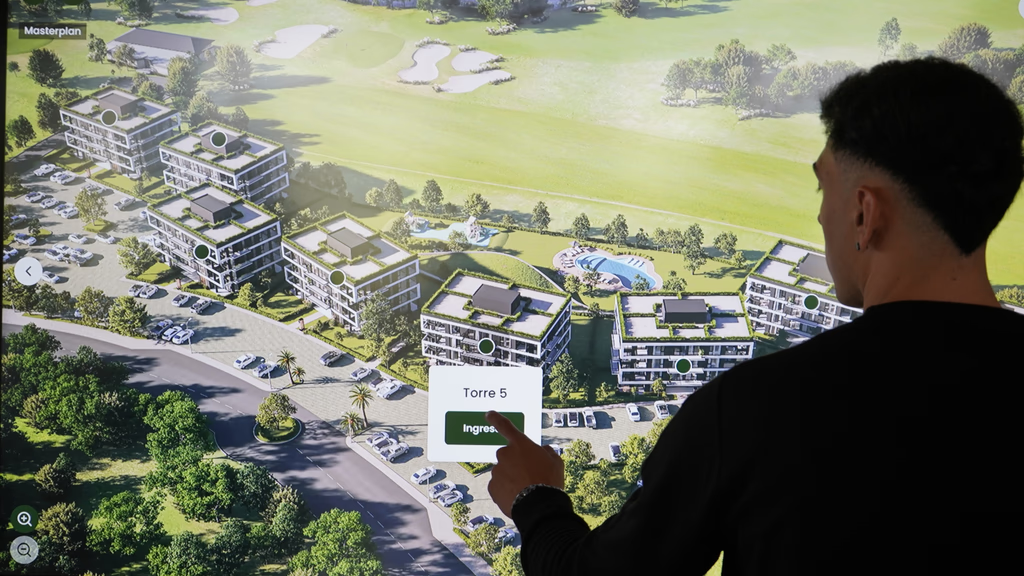
If you are in the real estate world, you have probably already heard the term. But if you are still not quite clear on what a Virtual Showroom is, how it works, or what it is for, this article is for you.
No technical jargon. No beating around the bush. Let's get to the point.
The situation everyone knows
Imagine you are developing a real estate project. There is no construction yet, no model unit, nothing physical to show a potential buyer.
What do you do? What everyone used to do not long ago: you gather the renders you commissioned, put them in a PDF, add an Excel sheet with the availability of units, and send it to the interested party via WhatsApp.
The buyer opens the PDF, sees some images, doesn't quite understand the scale of the project, doesn't know if the unit they are interested in is available, and has to call the seller to ask three basic questions.
The seller doesn't always have updated information. The spreadsheet sent last week has already changed. And the meeting they finally coordinated lasts forty minutes explaining things the buyer should be able to see on their own.
That, in many projects, is still happening today.
What is a Virtual Showroom
A Virtual Showroom is basically a digital sales room for your project, accessible from the internet.
It is not a generic website. It is not an interactive PDF. It is a platform built specifically for your development, where anyone can enter from their mobile phone, computer, or tablet, and tour the project as if it were already built.
Without downloading any app. Without installing anything. Just with a link.
From inside, you can see the entire building, navigate floor by floor, enter a specific unit, take a 360-degree tour as if you were physically there, view renders of the spaces, consult the unit plan, check which units are available and which have already been sold — all in real time — and even download the technical sheet of what interests you.
All of that, at any time of the day, from anywhere in the world.
What does a Virtual Showroom contain?
It depends on the project, but generally, a well-structured Showroom includes:
A complete 360° tour. You can virtually walk through common areas, amenities, hallways, and enter each unit. It is the closest experience to being physically in the place.
Navigation by floors and units. You can see the building floor by floor, choose the unit you are interested in, and access all its content: interior renders, furnished floor plan, and the sheet with all relevant information.
Real-time availability.No outdated spreadsheets. The developer logs into their panel and with two clicks updates which units are available, reserved, or sold. The buyer sees it instantly.
Search engine with filters.If the project has many units, the buyer can filter by rooms, floor, orientation, price, and quickly find what they are looking for.
Construction progress.Photos and videos of the construction progress can be uploaded so that buyers who have already invested can see how it is advancing, and those who are still hesitant can gain more confidence.
Integrated forms and contact.The interested party can inquire without leaving the Showroom, directly via WhatsApp or through a form that reaches the sales team.
What is it really for?
The short answer: to sell faster and with less friction.
When a buyer can explore a project on their own, at their own pace, without relying on a salesperson to explain everything, the decision-making process changes. They arrive at the first meeting already having seen the project, already with a unit in mind, already with specific questions. The sale progresses much faster because the buyer has already covered half the journey on their own.
And everything changes for the sales team as well. Instead of explaining the project from scratch in every meeting, they send the link and the project explains itself.
Is it only for large projects?
No. That is one of the most common myths.
A Virtual Showroom makes sense for any project that needs to be shown and sold before it is completed. It can be a building with ten units or one with nine hundred. It can be a gated community, a shopping center, an office complex, or a housing development.
What matters is not the size of the project — it is the need to present it clearly and credibly before it physically exists.
How is one made?
At Urbania, the process starts with the project plans. That is all we need to get started.
Our content team takes those plans and converts them into renders, furnished 3D plans, 360° tours, videos, and all the visual material that the Showroom needs. Then we build the platform, customize it for the project, and deliver it ready to use.
The developer also receives their own administration panel to manage availability, upload construction updates, view metrics on who entered and what they looked at, and handle the leads generated by the Showroom.
From the plans to the Showroom ready to sell. Without the developer having to coordinate with five different providers.
Is it just for developers?
Not exclusively. More and more real estate agencies and brokers are hiring the Showroom directly, because they are the ones who use the tool every day to show the project to their clients.
And it makes sense. If you are the one who has to sell, you need the best possible tool to do it.
To conclude
The Virtual Showroom does not replace the relationship between the seller and the buyer. It does not replace a good value proposition or a well-thought-out project.
What it does is eliminate friction. It allows the buyer to see, understand, and fall in love with the project before talking to anyone. The sales team arrives at each conversation with the visual work already done.
In a market where there are more and more projects competing for the same buyer's attention, the way you showcase your development makes a difference.
And a Virtual Showroom is, today, the most effective way to show it.
Do you want to see how your project would look when digitized? Visit [urbania3d.app](https://urbania3d.app) or write to us directly.